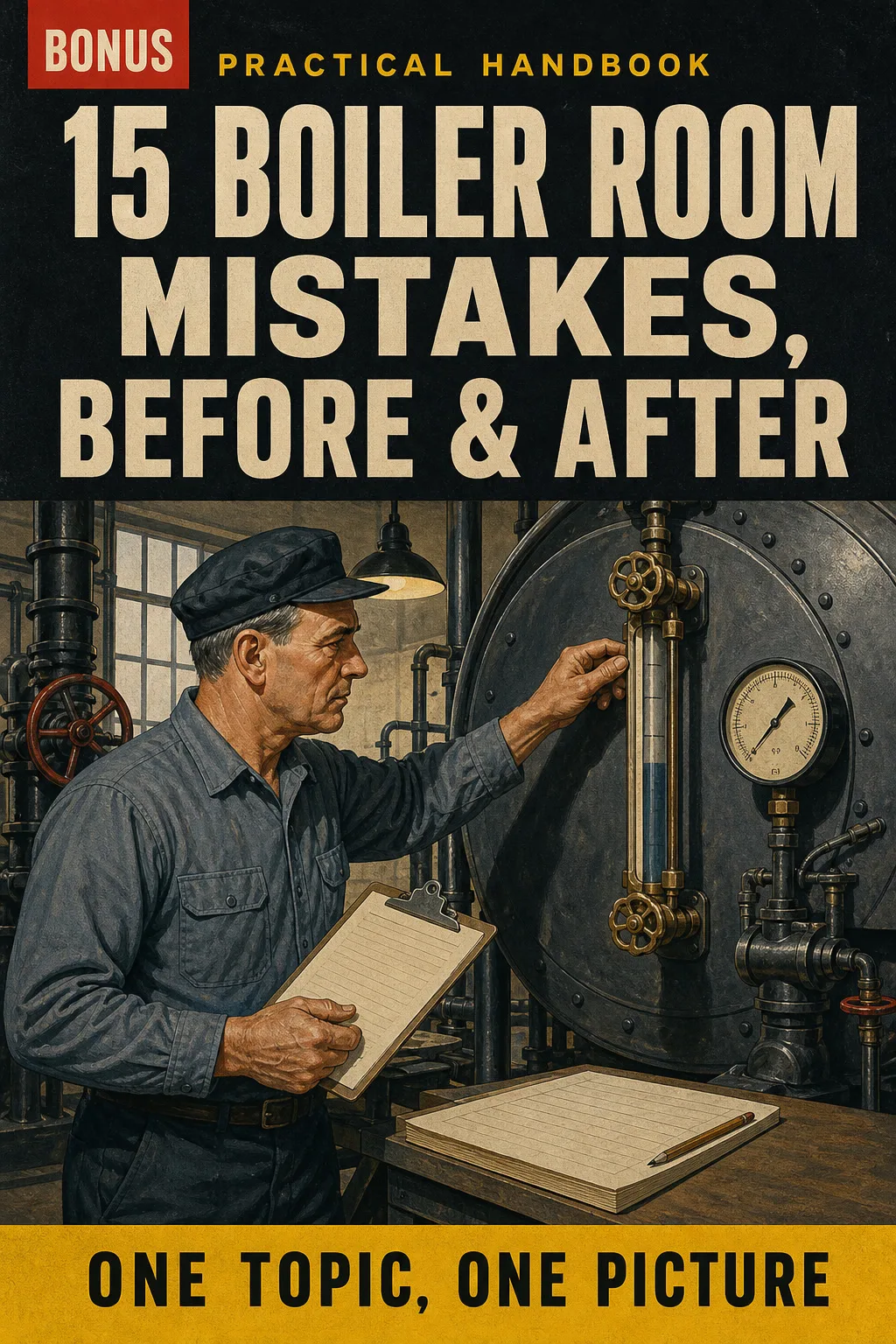
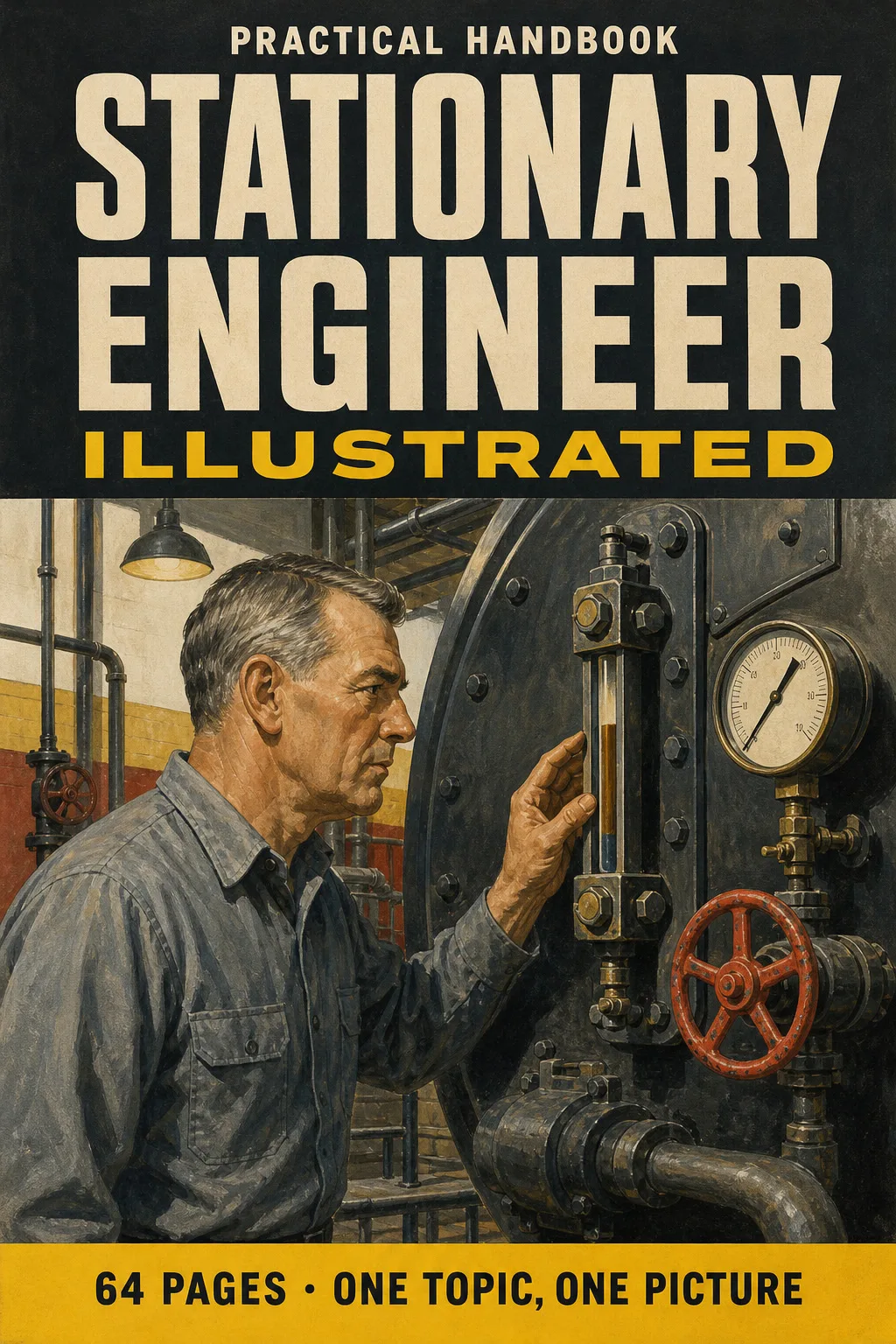
📄 Digital book in PDF · read it on your phone or print it
Fire-tube and water-tube boilers, safety valves, the water column, the low-water cutoff, combustion and draft, water treatment, blowdown, startup and shutdown. 64 illustrated pages, one topic each: first the drawing, then what you need to remember. 64 illustrated pages.
🔒 Secure checkout · PDF by email · 30-day guarantee
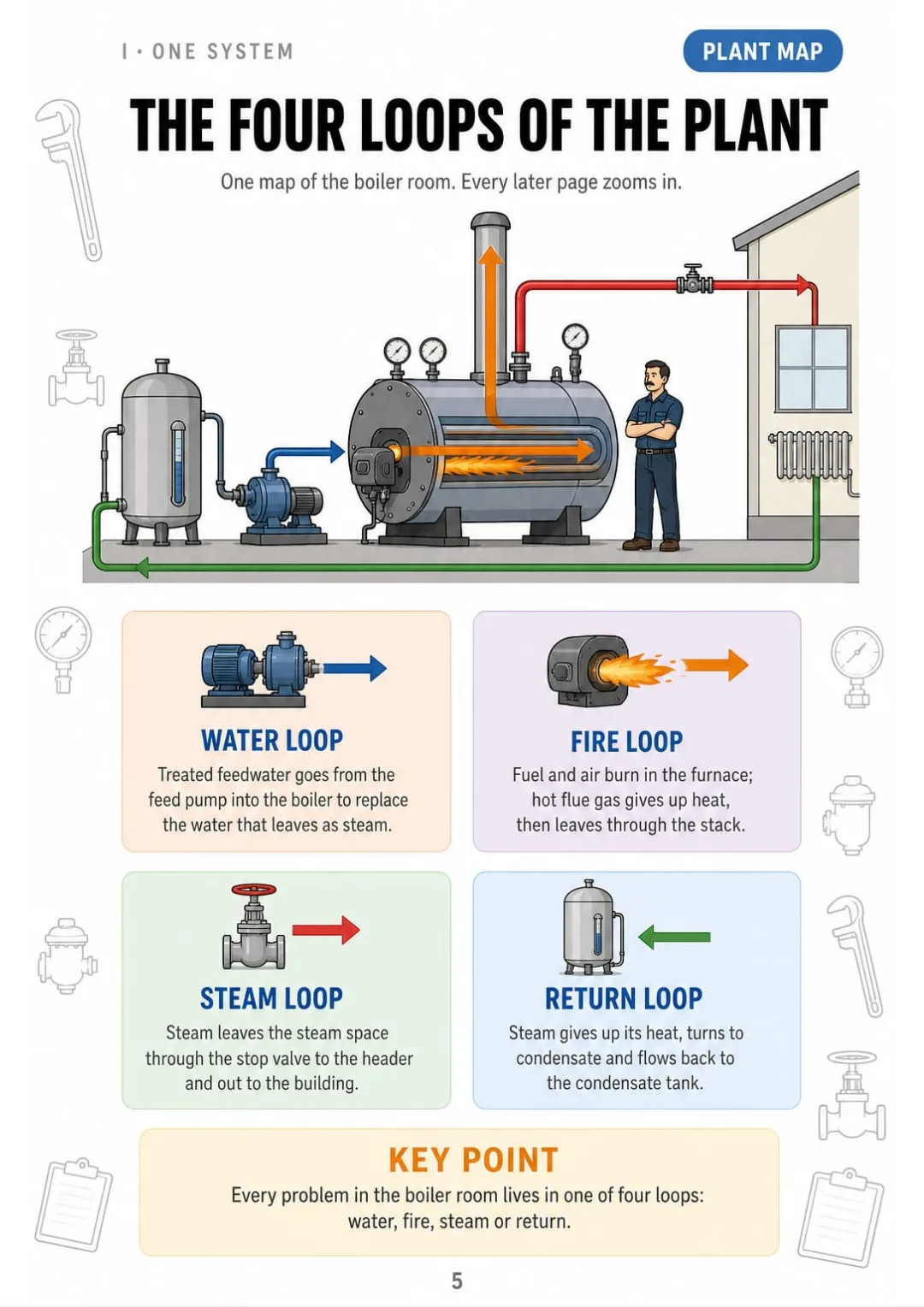
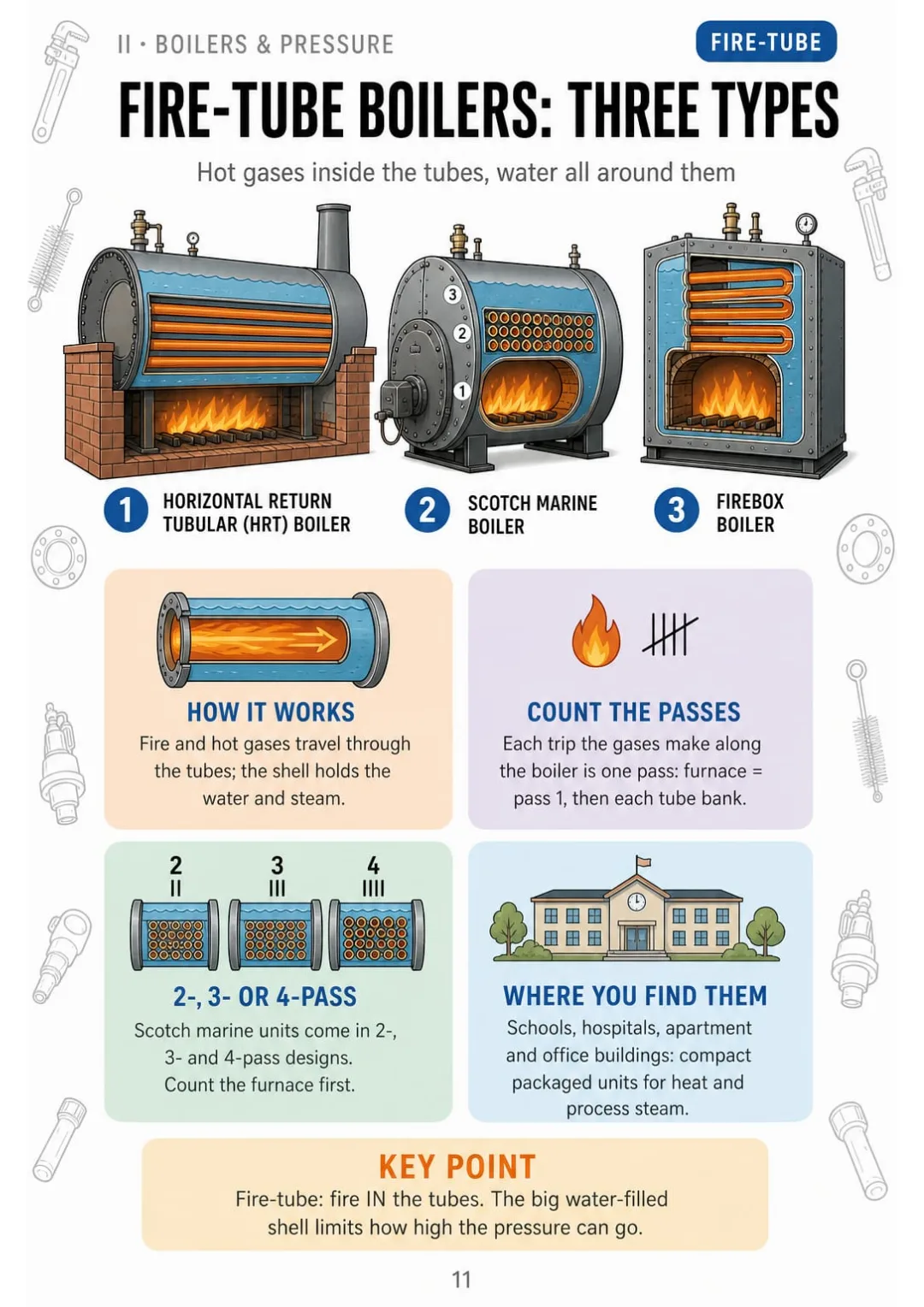
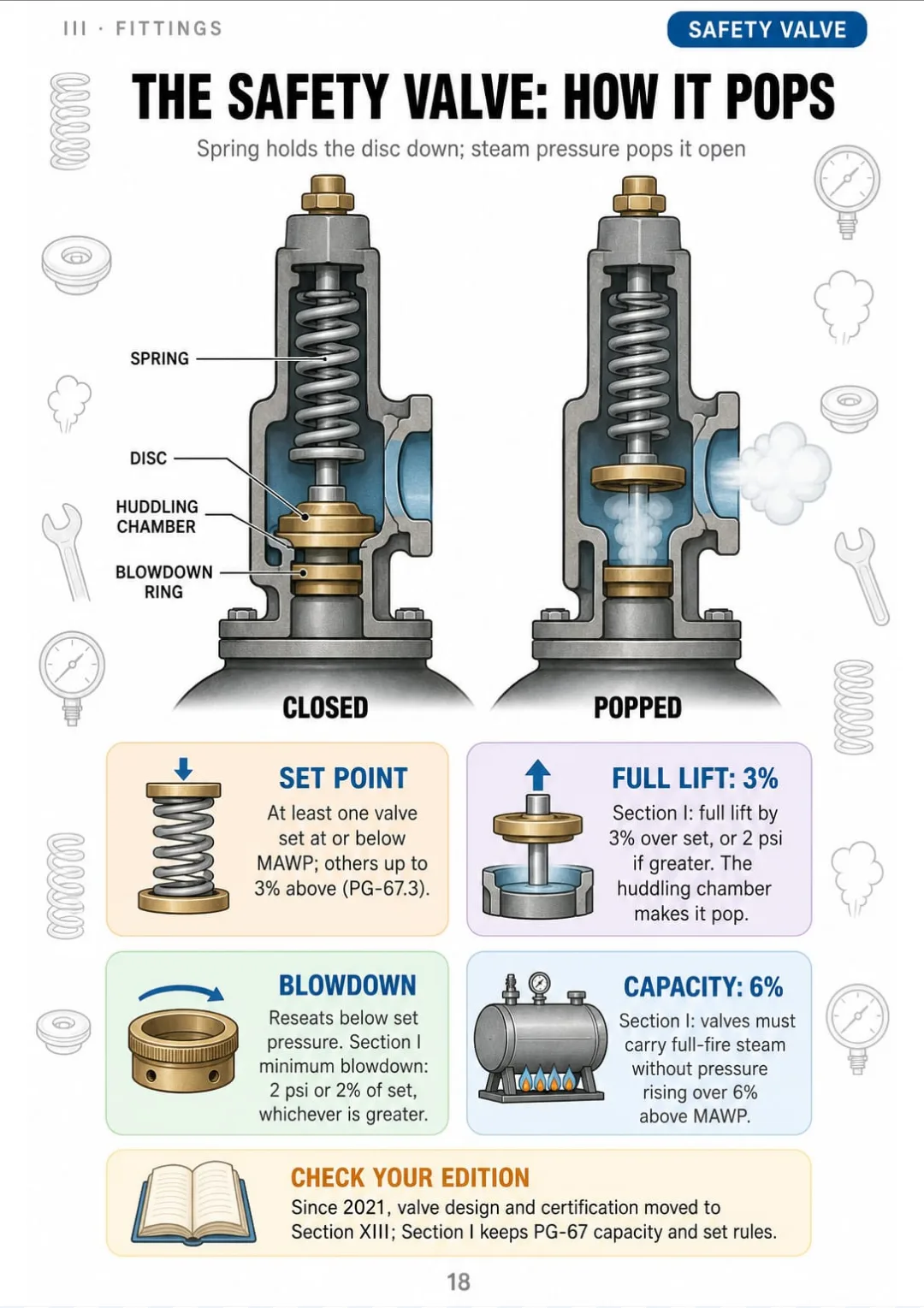
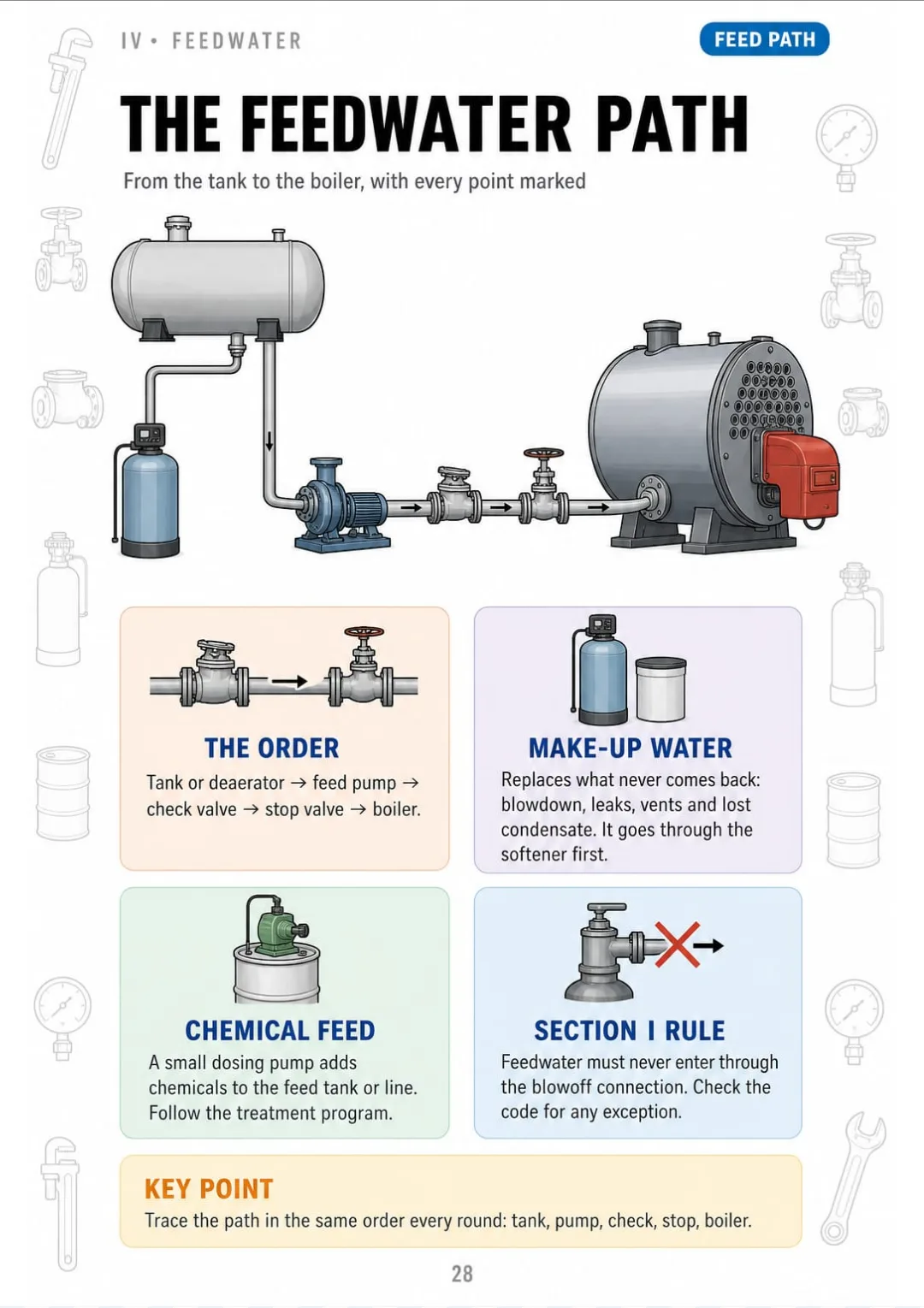
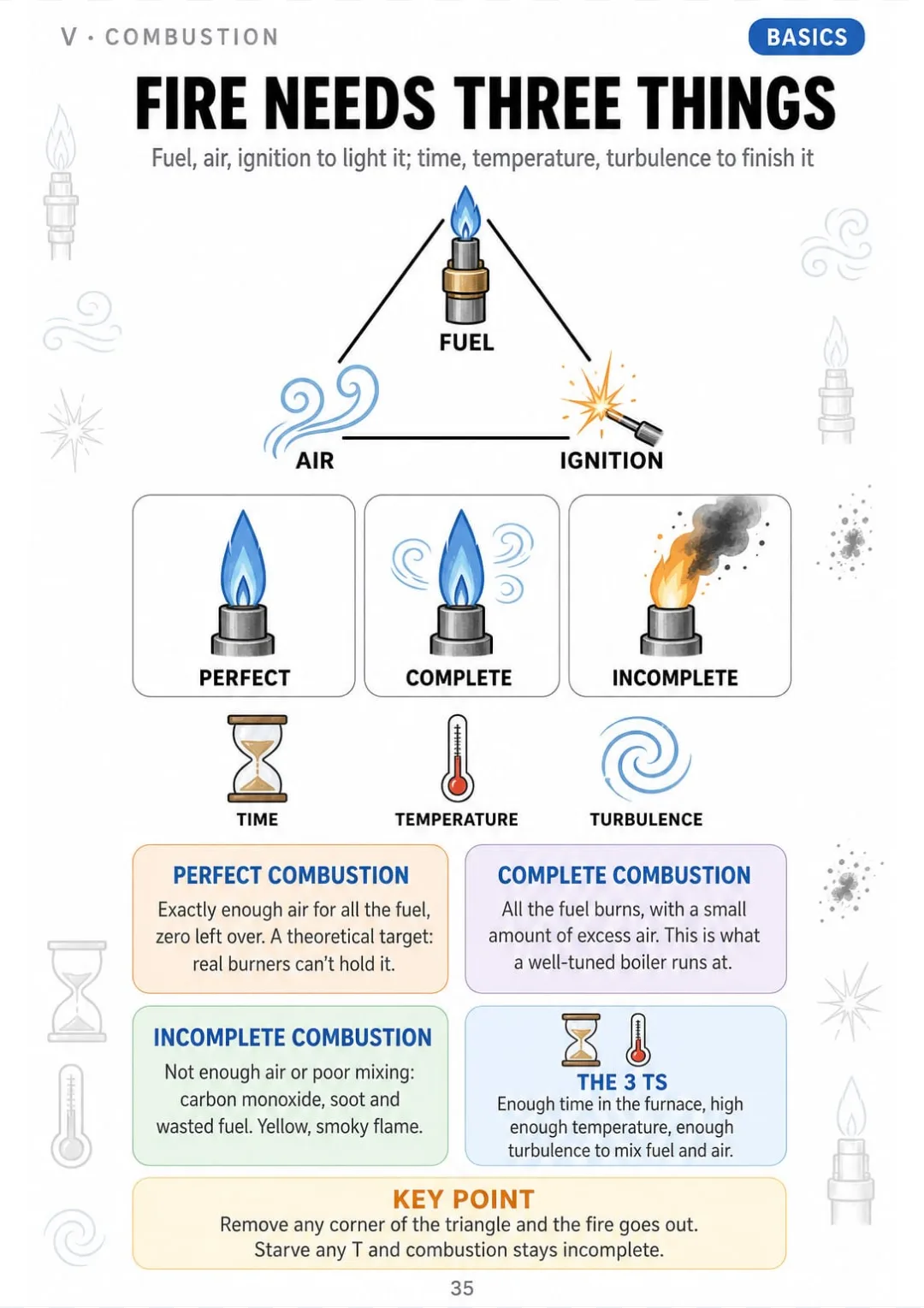
Every page has one big drawing and a box with the code values and steps you need to know:


Swipe to see more →
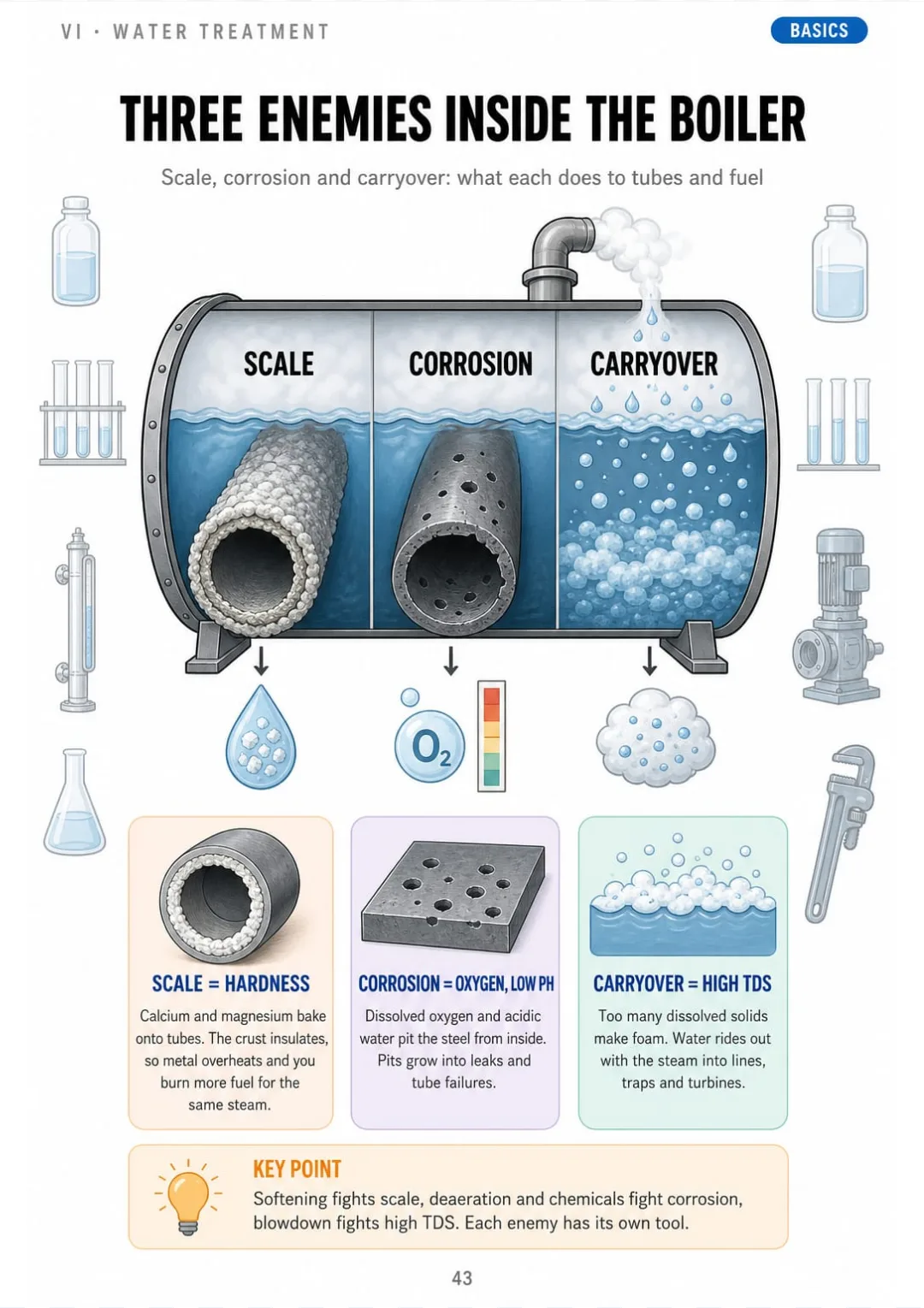
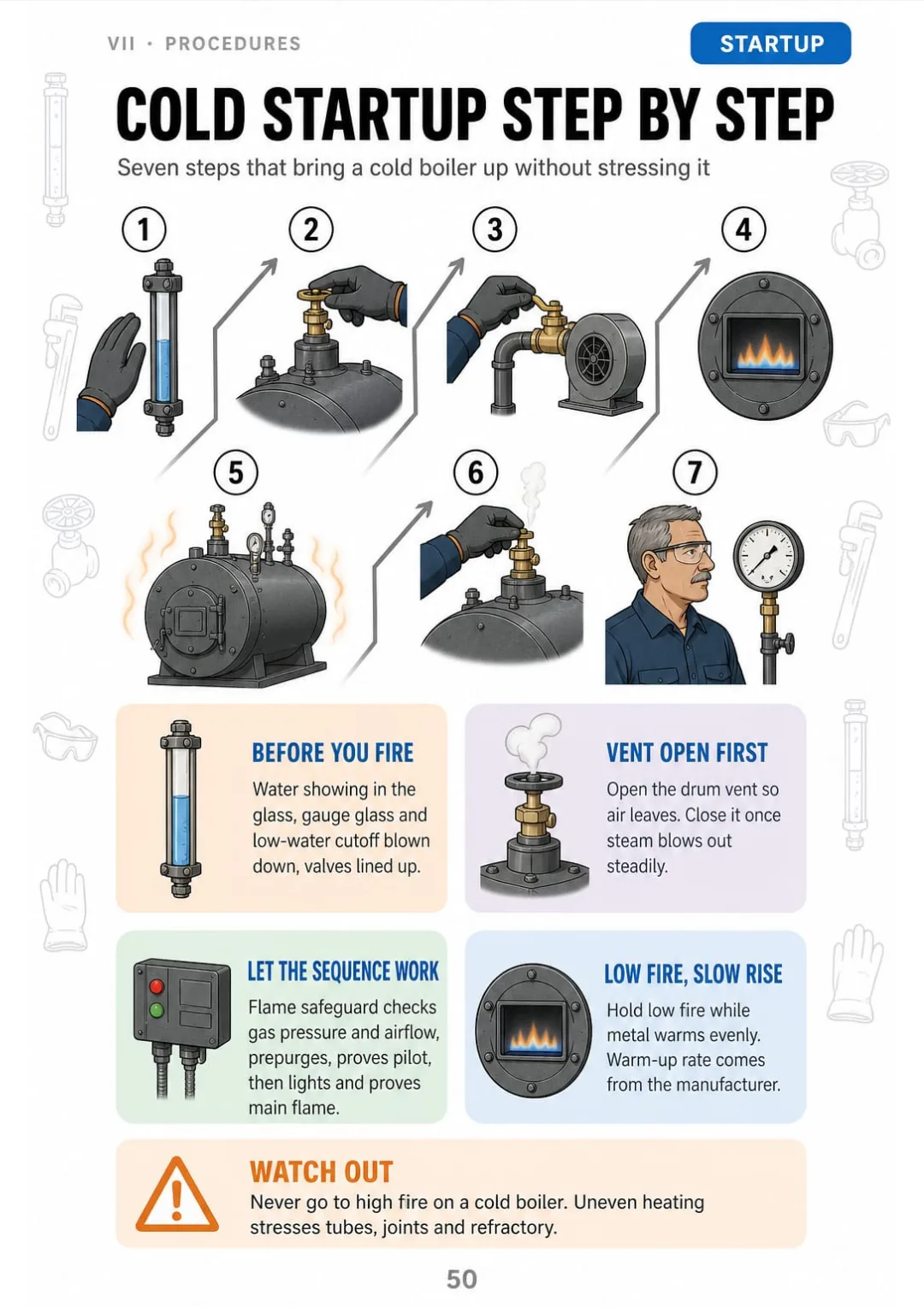
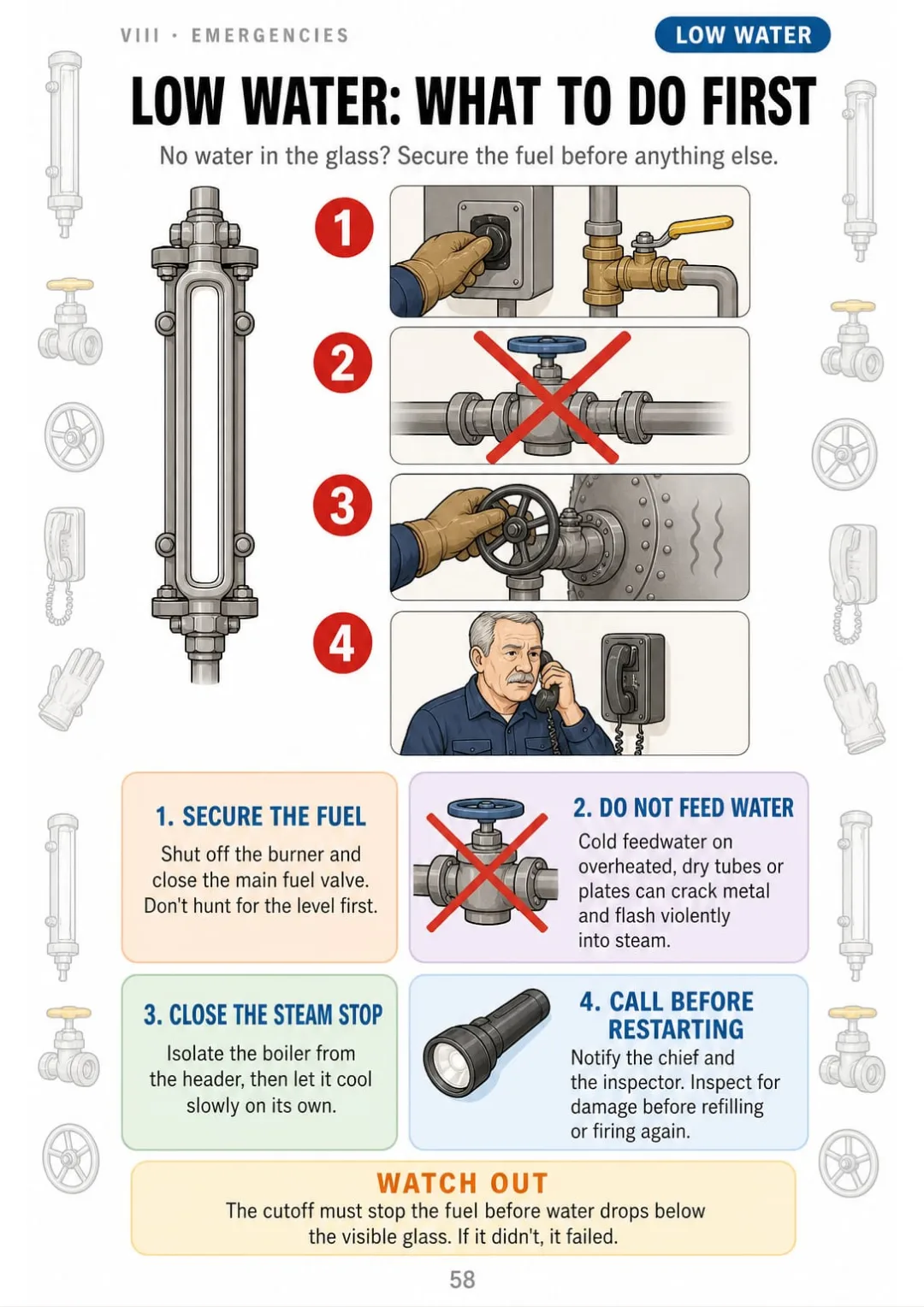
These are real pages from the book. The table of contents is the full one: 8 parts and 60 topics.
You're at the exam table and the question asks how much overpressure a Section I safety valve needs to reach full lift, and how far it drops before it reseats. You know you read it. You can't find it.
The manual covers the safety valve in three dense paragraphs: popping pressure, huddling chamber, accumulation, blowdown. All words, no picture of what moves inside the valve. By the next shift, the terms run together.

In this book, the safety valve is one page. You see the spring, the disc and the huddling chamber in a cut-away drawing: pressure rising, the valve popping, and a box with the numbers: full lift within 3%, blowdown 2 psi or 2%, whichever is greater, marked to check against your state's edition.
The water column, the low-water cutoff, the gauge glass blowdown, bottom blowdown and cold startup work the same way: each one on its own page, with its drawing and its steps.
You get how the valve works and you can explain it, at the exam or at the boiler, without going back to the manual.

The boiler room as one system, boilers and pressure, fittings and safety devices, feedwater and steam, combustion and draft, water treatment and blowdown, step-by-step procedures, and emergencies and exam review: 64 pages, all illustrated
Think of it this way:
You're on rounds and the gauge glass shows no water. You need the first move, not the third.
You open the low-water page and see it drawn as a card: secure the fuel, no feedwater, close the steam stop, let it cool, call the inspector. In that order, every time.

Same with the feedwater path, the flame safeguard sequence, bottom blowdown, testing the low-water cutoff and cold startup: each one has its own page.
Stationary Engineer Illustrated is 8 parts and 60 topics, all drawn, with the exam math on one page and a boiler room checklist at the end.
What you see drawn, you don't have to memorize.
The four loops of the plant (water, fire, steam, return), what a boiler does, low vs. high pressure, steam vs. hot water, who writes the rules and your daily rounds in one picture.
Fire-tube and water-tube boilers, cast iron and copper-fin heating boilers, psig vs. psia, saturation, feet of head and boiler horsepower.
Safety valve and relief valve, water column and gauge glass, water column vs. low-water cutoff, pressure gauge and siphon, fusible plug, feedwater and steam stop valves.
The feedwater path, feed pumps and NPSH, the deaerator, four types of steam traps, condensate return, water hammer, priming, foaming and carryover.
The combustion triangle and the 3 Ts, excess air, the gas train, the fuel oil system, draft types, the flame safeguard sequence, flame failure and why purge matters.
Why treat boiler water, softeners and hardness tests, oxygen and pH, bottom vs. surface blowdown, blowdown step by step and wet and dry lay-up.
Cold startup, cutting in on the header, normal shutdown, both low-water cutoff tests, testing the safety valve, switching pumps and burners, and the annual inspection.
Low water, high water and flame failure, tube failure and gauge glass break, lockout/tagout, how the state exam works, exam math and the most frequent mistakes.
At the end of the book: Exam math on one page and a boiler room checklist with the most frequent mistakes.

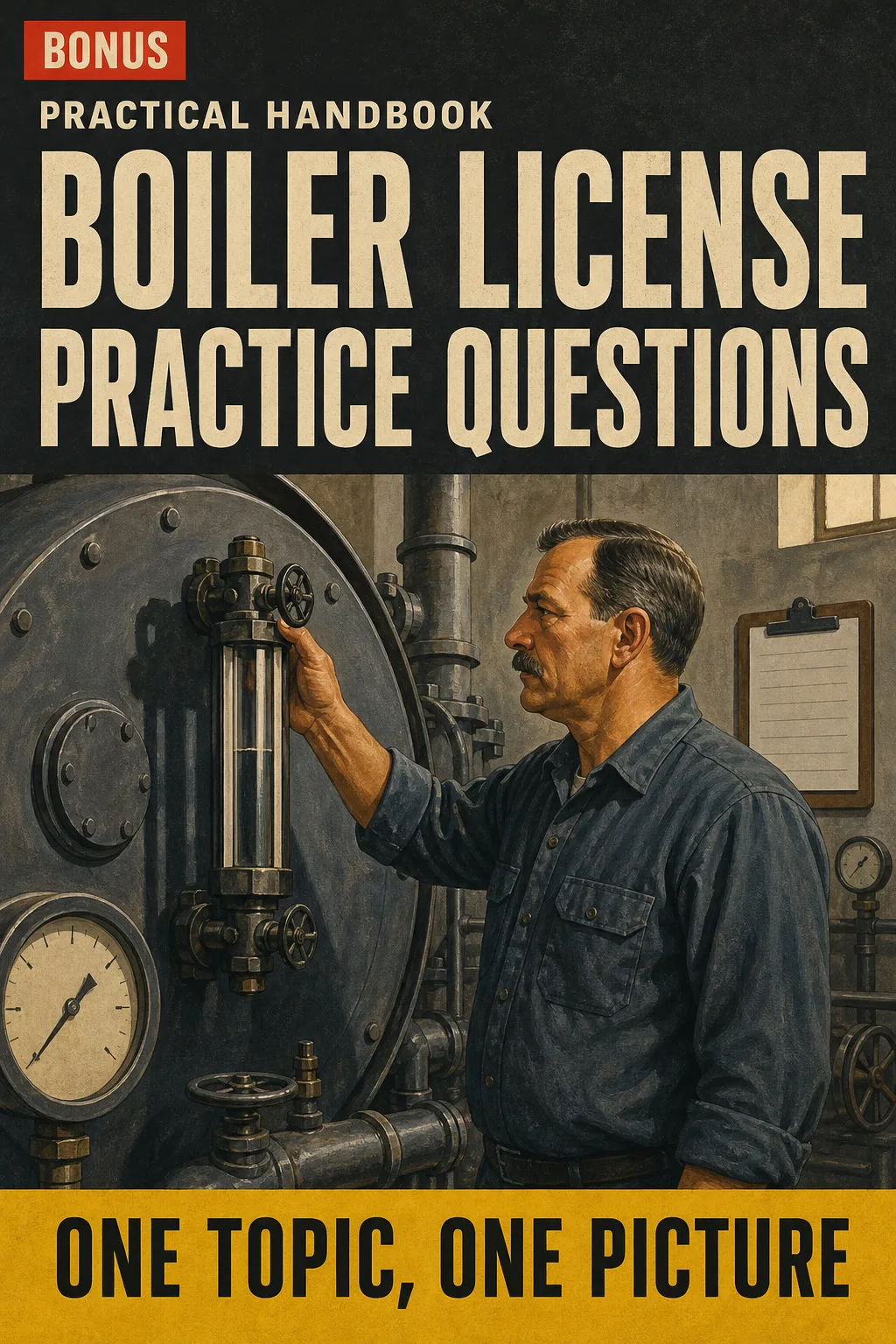
Exam-style questions on fittings, combustion, water treatment and emergencies, each with the answer explained and the page to go back to, so you find your weak spots before test day.

The most common boiler room mistakes drawn side by side, wrong and right, from blowing down the water column to feeding cold water into a dry boiler, so you can review them in minutes.
📄 This is a digital PDF book sent to your email: nothing is printed or shipped.
PDF by email: We email you Stationary Engineer Illustrated as a PDF, together with the two free books. It's a single payment: no installments, no extra charges.
You see the boiler room as four connected loops instead of a pile of separate fittings. Each fitting and procedure on its own page, easy to review on a break.
You review the code values, the exam math and the procedures in the same order every time, then check your weak spots with the practice questions.
You print the pages you need and keep startup, blowdown and low-water steps at hand on your rounds.
📄 This is a digital PDF book sent to your email: nothing is printed or shipped.
Try Stationary Engineer Illustrated for 30 days, bonus books included.
We refund everything if the file won't open, if the book isn't what you see here, if you were charged twice or if the email doesn't arrive. Just email us.
You pay once. No subscriptions.
Yes. It doesn't start from what steam is: it shows the boiler room as one system and goes straight to fittings, code values and procedures, one drawing per topic.
From the ASME Boiler and Pressure Vessel Code (Sections I, IV, VI and VII), ASME CSD-1, NFPA 85 and the National Board Inspection Code. Every code value is marked to check against the edition your state or city adopts.
No. It's an independent study book. It doesn't give you a license, a certificate or training hours, and it isn't affiliated with any state, city, licensing board, ASME, NFPA or the National Board.
No. It's study material to go with your course, your on-the-job training, the manufacturer's instructions and your employer's procedures, including in emergencies. It isn't another thick manual: it's what you open after it, one topic per page, with the fitting drawn and the steps in the same order every time.
No. They're written for this book in exam style, with the answer explained and the page to go back to. They aren't official questions from any exam.
The book and the 2 bonus books come as a PDF by email, to the address you enter at checkout. It's a one-time payment, not a subscription.
It covers the boiler content that stationary engineer and boiler operator exams draw from: ASME code values, fittings, combustion, water treatment and procedures. Each state or city sets its own license grades and adopts its own code edition, so check your board's requirements and the edition it uses.
Yes. The PDF is printable, so you can print the whole book or just the pages you want to keep at the boiler.
You have 30 days. We refund everything if the file won't open, if the book isn't what you see on this page, if you were charged twice or if the email doesn't arrive: just email us.
No more rereading without anything sticking.
The water column and the low-water cutoff, drawn so they finally click.
You walk into the exam knowing where everything is.
Drawings make studying faster.
The book is right below.
One-time payment: US$ 27 · Guarantee: 30 days · PDF by email
YES, I WANT STATIONARY ENGINEER ILLUSTRATED FOR US$ 27📄 This is a digital PDF book sent to your email: nothing is printed or shipped.